

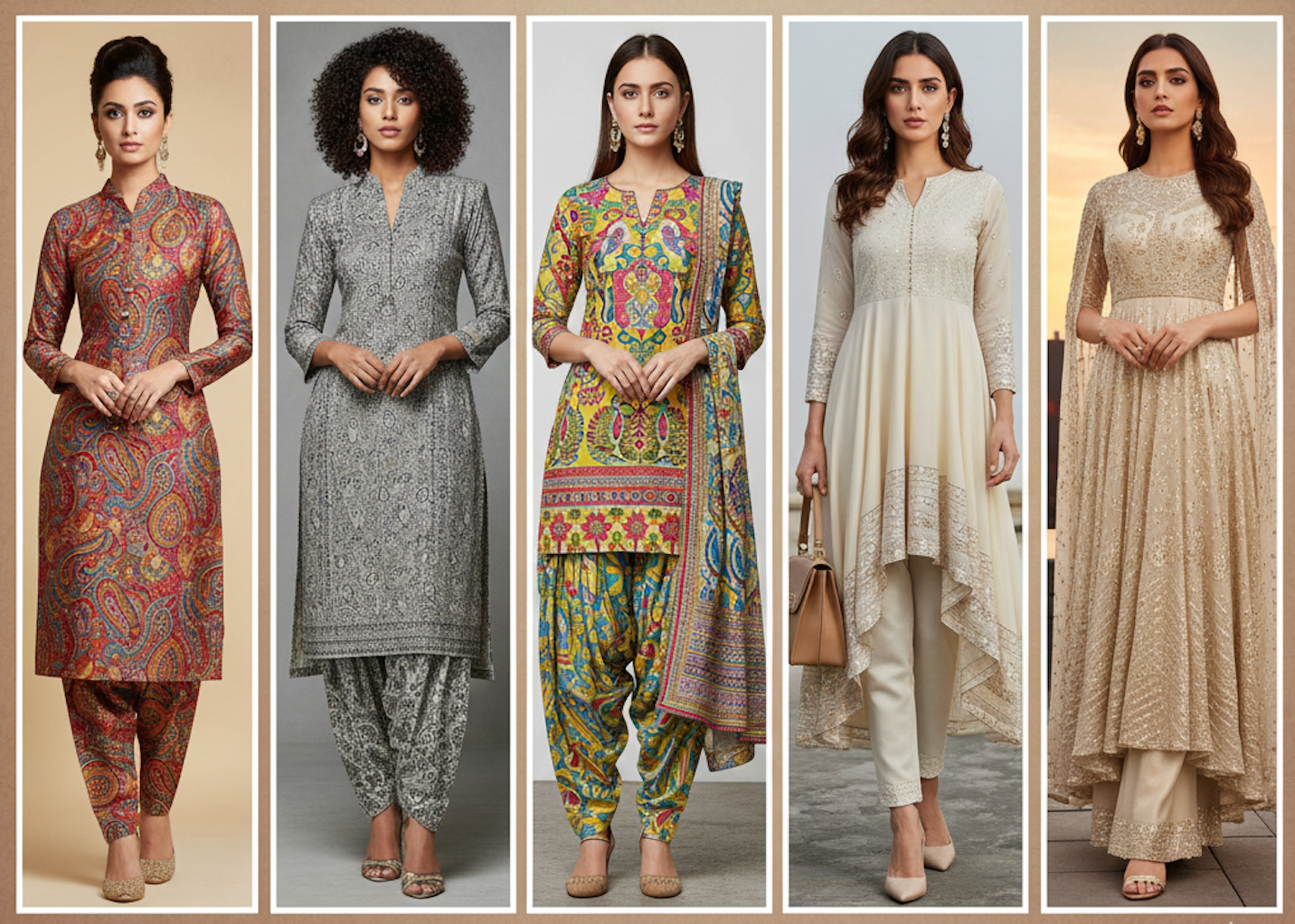
The Salwar Kameez, a universally cherished ensemble across South Asia, is more than just clothing; it is a historical garment that has masterfully navigated centuries of fashion change. What began as functional, courtly attire in Central Asia and the Mughal Empire has evolved into a versatile, indispensable fashion statement.
The Evolution of Style and Silhouette
Historically, the Kameez (tunic) was cut long and straight, often reaching the knee or below, paired with a heavily pleated, voluminous Salwar (trousers) cinched tightly at the ankle. This classic silhouette, favored by Mughal nobility for horseback riding, prioritized modesty and mobility.
The 20th and 21st centuries introduced radical stylistic shifts:


Source: https://www.hindustantimes.com/photos/lifestyle/mrunal-thakur-looks-ethereal-in-pastel-pink-embellished-salwar-suit-101688727173896-6.html
- 1960s–1980s: The advent of the Churidar (trousers cut on the bias, creating tight folds or 'churis' at the ankle) provided a sleeker look. The Kameez remained moderately structured.
- 1990s–2000s: The emergence of the Patiala Salwar (extremely voluminous, pleated trousers) and the fitted, shorter Kurti (a modern, shorter version of the Kameez) gave way to more playful, regional styles.
- Contemporary Era (Post-2010): We are witnessing the rise of the Cigarette Pant and the Palazzo, replacing the traditional Salwar entirely. The Kameez itself has morphed into A-line cuts, high-low hemlines, and Anarkali flares, borrowing heavily from Western draping techniques to create dramatic, floor-length silhouettes. The modern Kurti often functions as a stand-alone tunic, easily paired with jeans or leggings, reflecting a complete merging of utility and fashion.
The Material Transition: Embracing Comfort
The material choices for the Salwar Kameez directly reflect a shift from heavy formality to breathable comfort. Initially, the garment was predominantly crafted from luxurious, dense fabrics like heavy silk (Brocade, Velvet) and fine muslin, signaling status and wealth.
Today, the emphasis is firmly on practicality and comfort. Cotton, linen, rayon, and crepe dominate the market. These materials offer exceptional drape, are easy to maintain, and are perfect for warm climates. Even silk variants like Tussar and Chanderi are favored for their light weight and breathability, allowing for sophisticated styling without the historical bulk.
Modern Wearability: Stitched and Styled for Today
The Salwar Kameez has achieved its current ubiquity through its sheer adaptability. Modern stitching and styling options allow for endless customization:
- Fusion Stitching: Designers now incorporate deep pockets, detachable collars, and asymmetric cuts. The Kurti is often slit high to be worn over trousers rather than the traditional voluminous Salwar.
- Versatile Layering: The Kameez/Kurti can be worn open over a contrasting top, cinched with a belt, or styled with capes and jackets for a layered look.
- Bottom Wear Diversity: The classic three-piece set (Salwar, Kameez, Dupatta) has evolved into a mix-and-match two-piece set (Kurti + Palazzo/Cigarette Pants) or even a one-piece Kurti dress, perfect for casual outings or office wear.
The Salwar Kameez endures because it retains its fundamental comfort while effortlessly adopting every new trend, proving that it is the ultimate garment for the modern, dynamic individual.
Share:
The Ultimate Style Power: Why Unstitched Salwar Suits Reign Supreme